
The capital flywheel: how competition in Aussie banking is fuelling ETA
The debt market for ETA acquisitions in Australia and New Zealand is beginning to shift. Lenders are becoming more comfortable with the ETA risk profile, leading to competition for deals and more favourable financing terms for searchers.
If you were a searcher in Australia or New Zealand back in 2021, a conversation with a senior lender often felt like a tutorial. You weren't just pitching a specific deal, you were pitching the entire concept of entrepreneurship through acquisition. You had to explain why a young operator with no assets but a decent track record was a safe bet for a cash-flow loan.
It was an uphill battle. The capital was there, but you had to work hard to get it.
Fast forward to late 2025. While we are still early in this market's development, the dynamic has shifted.
As we discussed in our last post, the ANZ search fund market is gaining momentum. Debt capital is important fuel to that fire, driven by exceptional entrepreneurs proving that the model works. And right now, that fuel is becoming higher octane and easier to access.
Banks remain rigorous, and rightly so. However, we are seeing a fierce rivalry among the major institutions. Lenders are beginning to understand the ETA risk profile. For the first time, sophisticated searchers are seeing genuine lender competition for their mandates.
In this post, we'll unpack the current state of the domestic debt market. We'll look at the shifting appetites of the Big 4, the emergence of non-bank alternatives, and the subtle but meaningful improvements in leverage terms helping searchers close good deals.
The macro view: a rising tide
Looking at the latest APRA statistics, the sheer volume of capital moving into business lending is undeniable. Over the last 24 months (August 2023 to July 2025), the major banks have significantly expanded their books.
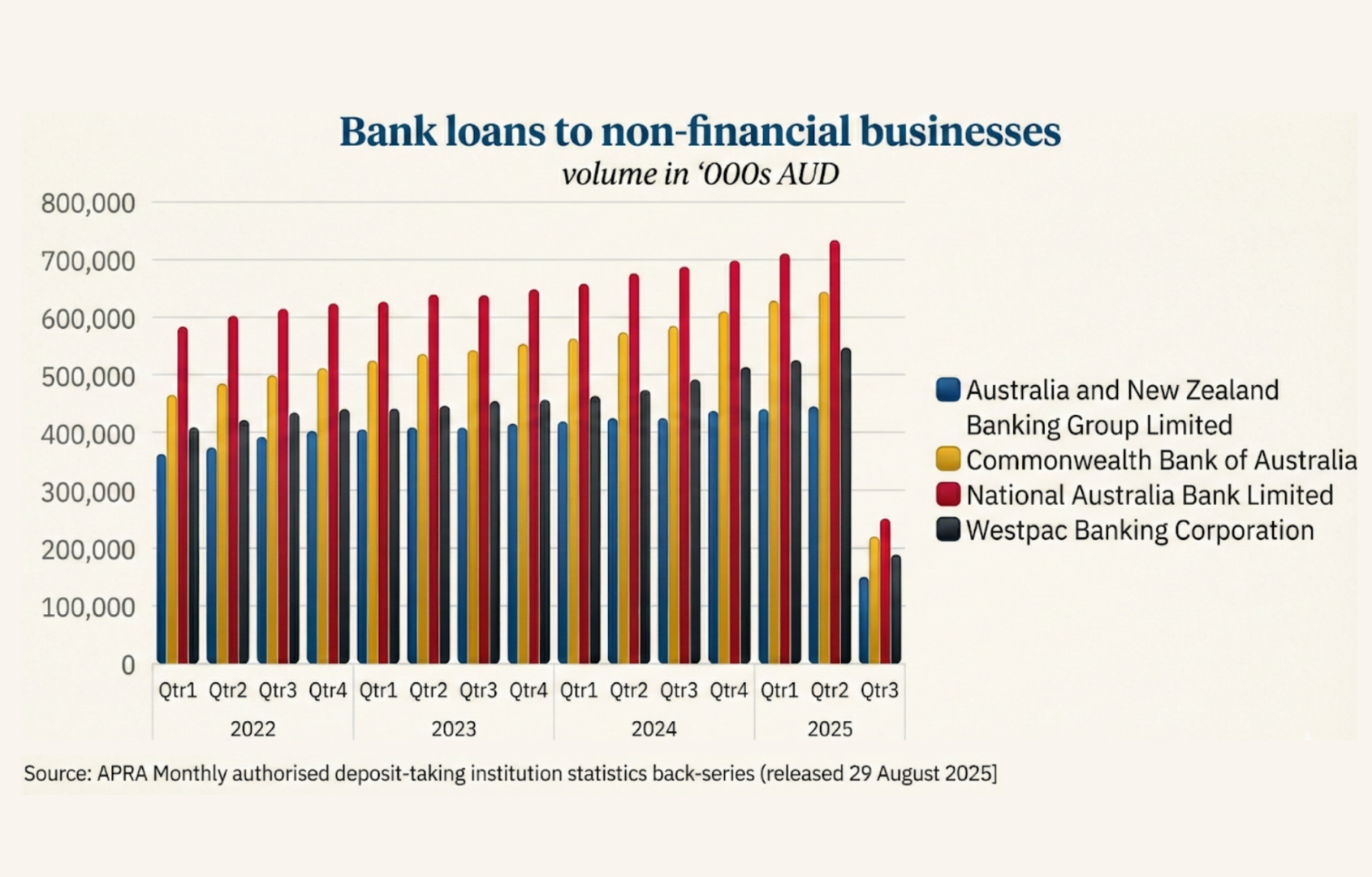
The data shows a clear upward trajectory.
NAB and CBA led the charge. Each added nearly $38 billion in business loans over this period.
Westpac is accelerating hard, growing their book from $150B to $186B.
ANZ, while still growing, has taken a more conservative line, adding $14.6B.
The banks appear to be in a strategic arms race for the SME balance sheet. While search funds represent a fraction of this volume, the ETA-style transaction, leveraged buyouts of boring businesses, has moved from the too hard basket to the highly desired basket for credit committees chasing yield.
Which Big 4 Banks are most competitive for ANZ ETA Deals?
The Big 4 are often viewed as a monolith, but right now, they are playing very different games.
Drawing on data and insights provided by Tom McGhie at Balmaghie, who has helped many search fund entrepreneurs to navigate the debt landscape, here is where the players stand.
The incumbent: CBA
CBA remains the predominant lender by volume in the ETA space. They have maintained a consistent growth appetite from 2021 through to today. Because they have been active in this specific niche for longer, they have the data to back their decisions and are consistently open for business.
The challenger: NAB
NAB is in a heavyweight fight for the title of Australia's largest business bank. To win share, they are competing on multiple fronts: rate and structure. In a significant shift for the mid-market, we are seeing them contemplate net debt calculations for operating leverage in specific circumstances.
This is a lever that hasn't been used in this segment since 2007. While this isn't a blanket policy, it allows you to net off the cash on the target's balance sheet against your gross debt. In a cash-rich ETA target, this can unlock additional capacity.
The comeback: Westpac
Westpac is perhaps the most interesting story of the last 18 months. Until recently, they were effectively restricted from lending to PE-style transactions. That restriction has been removed, and they have re-entered the market with an offensive mindset. Their appetite has shifted rapidly from flat in 2022/23 to growth in 2025. However, there is still not strong support for smaller transactions.
The conservative: ANZ
ANZ has been the most cautious of the group. Their support for the ETA space has been modest relative to peers, and their appetite for ETA deals remains flat but with early signs of emerging appetite.
The race for market share
The intensity of this rivalry recently spilled over into the public eye. In August, the head of business banking at one of the majors critiqued competitors for aggressive pricing strategies, noting that some banks were "leading with price" in a way he deemed "stupidity".
He specifically called out peers for acting defensively and offensively to gain market share. While bankers may call it stupidity, for a searcher, this competition spells opportunity.
Why consider Non-Bank Lenders for ANZ ETA Deals?
While the major banks are fighting for market share, they are not the only game in town.
If you looked for a lending partner outside the Big 4 for an ETA deal in ANZ back in 2022, the list was short. Today, the ecosystem is expanding.
We are increasingly seeing challenger banks like Judo Bank appear alongside the majors in winning commercial deals. At the same time, private credit lenders are becoming more active in lending to ETA deals.
For a searcher, this diversity is important. While bank debt is almost always cheaper, non-bank lenders often trade on flexibility. They may offer looser covenants, different amortisation profiles, or a willingness to look at hairier deal structures that a credit committee at a major bank might flag. Having these alternative capital pools available means marginal deals, ones with great fundamentals but tricky structures, have a higher probability of getting funded today than they did three years ago.
How have ANZ ETA Operating Leverage Terms changed (2022-2025)?
The competition we described above is resulting in better terms for the entrepreneur. We are seeing a tangible creep in leverage terms that directly impacts the returns profile of a search fund acquisition.
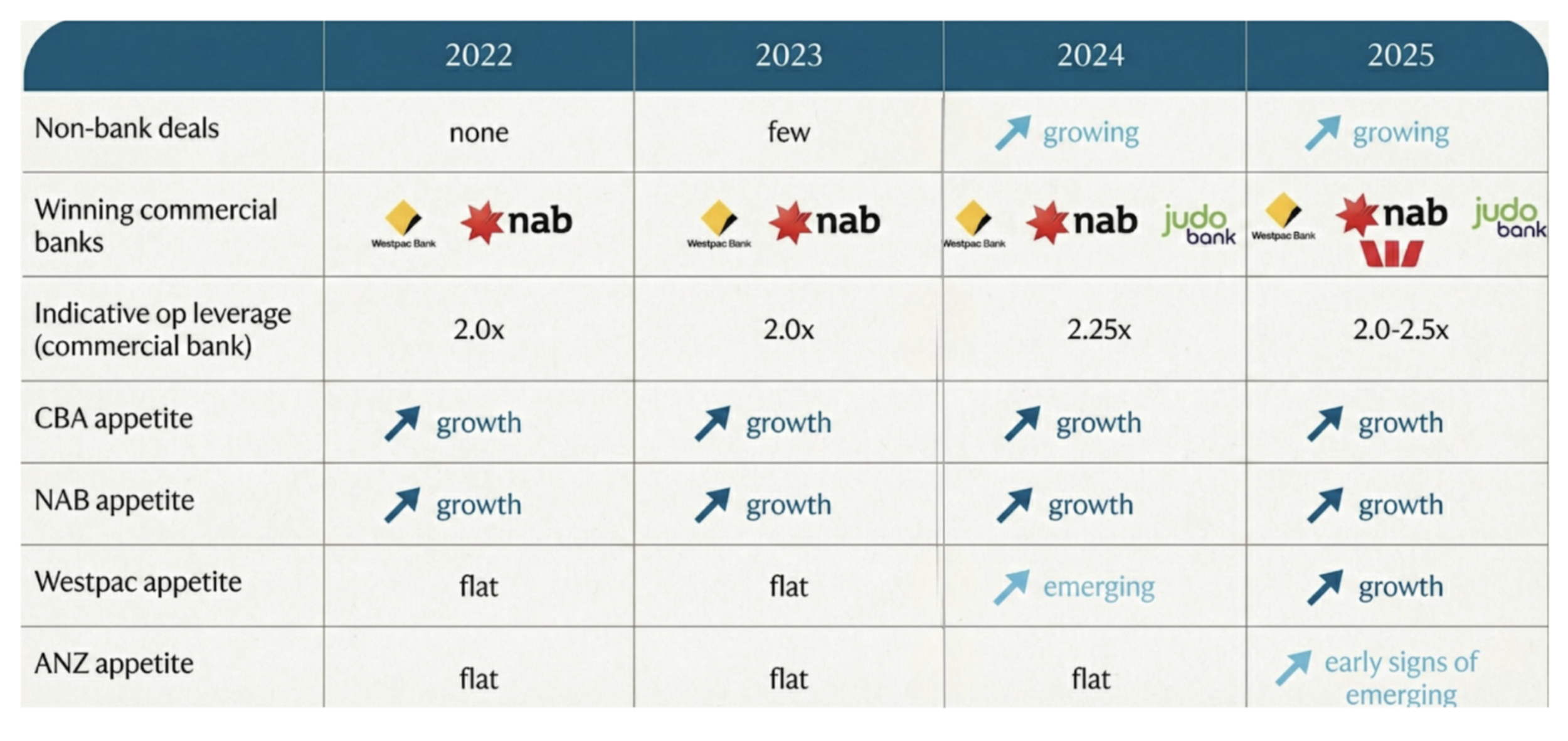
On the surface, an extra quarter or half-turn of leverage might seem minor. In practice, it is significant.
This expansion in leverage allows searchers to bid more competitively on high-quality assets without diluting their equity returns. It bridges the gap between a seller's price expectation and a searcher's valuation model. Importantly, this shift doesn't appear to be reckless lending. Rather, it's a sign of market efficiency. Lenders are becoming comfortable enough with the asset class to price the risk more accurately, moving away from the ultra-conservative buffers of the early years.
The new rules of engagement
The days of simply hoping for a term sheet are fading. The current dynamic in the ANZ debt market is one of intensifying rivalry, and for a searcher, that changes the playbook.
So, what does this mean for you as you head into your search?
First, competition is your friend. Just as you run a disciplined process to find a business, you should run a process for your debt. The variance in appetite between the Big 4 is wider than it has been in years. Don't default to the bank that holds your personal credit card or the one your parents used. Ensure your debt strategy reflects the reality of 2025, not the scarcity of 2022.
Second, look for structure, not just rate. While it's easy to fixate on the interest rate, the real value often lies in the terms. A shift to net debt covenants or a leverage cap that moves from 2.0x to 2.5x can do more for your IRR and your operational flexibility than saving a few basis points on the margin.
Finally, relationships still matter. While institutional appetites are growing, ETA lending remains high-touch. The banks winning right now—NAB, CBA, and increasingly Westpac—are investing in bankers who actually understand the mechanics of ETA. And as we’ve learned over the years, success has more to do with the banker than the bank.