
Why Hockey Sticks Break
The Hidden Danger of High Growth in Search Funds

The Counterintuitive Truth About Growth
A growing business is generally a sign of a working business. It is producing something the market wants more of and compounding value for its owners. In almost every investment context, growth is a positive signal.
Search funds are an exception. Past a certain rate of growth, the same signal that reads as strength elsewhere starts working against you. The target profile is built around stability for a specific reason. As the new operator, you're stepping into a business you've never run, in an industry where your experience may be limited, with debt sized against historical cash flows. The business itself is going through the most significant leadership transition it has ever experienced. A forgiving target profile gives you room to learn before you have to act.
A business growing at modest, durable rates fits cleanly inside that logic. A business growing at an unusually high rate doesn't. The same trajectory that would be straightforwardly attractive in a venture or growth-equity context raises three different questions in a search fund context. How operationally complex has the business become at this rate? What is the acquisition price doing as a result? And how durable is the underlying revenue?
None of this argues against growth. The point is narrower. The higher up the curve a target sits, the more carefully you have to read it. The features that make the model forgiving start working against you the moment growth begins demanding decisions the new operator hasn't yet earned the right to make.
The Operator Reality
The forgiving target profile exists because of a specific constraint. The HBR Guide to Buying a Small Business argues that a new operator should avoid making major changes in the first year. The point isn't that nothing should change. Small reversible decisions are fine to make early. The bigger calls, the ones that are expensive to get wrong and difficult to undo, benefit from the kind of understanding that only develops from time spent running the business.
A stable business gives you that runway. You can learn the business, the industry and earn the trust of people adjusting to new leadership. The slower clock is part of what allows an often first-time CEO to successfully grow a business in an industry they may not have experience in.
A fast-growing business runs a different clock.
Let's take the hypothetical example of a business doubling revenue year over year. The new CEO may have to decide whether to open a second office in another state to keep up with demand, whether to bring on a VP of Sales to professionalise a function the founder has been running personally, and whether to sign a five-year lease on a larger facility because the current one is full. Each of those decisions is hard to reverse. Each requires a level of operating conviction that the new CEO simply cannot have so early in the seat. The growth doesn't pause while you build that understanding. It forces you onto a timeline you didn't set.
In venture capital, that kind of operating pressure is rational. The asset class needs companies to move fast enough to reach the scale that justifies a high-failure portfolio model. The trade-offs that follow, deferred profitability, aggressive reinvestment, rapid hiring, all derive from that imperative. A search fund operator is in a different position. They're inheriting velocity they didn't create, in a business they're still learning to read, inside a model that doesn't require that velocity to generate returns.
What the model offers a new operator is time. High growth takes it away.
The Multiple Trap
The second way high growth changes the risk profile of a search fund deal is mechanical. It runs through the price.
Rick Ruback, one of the professors who teach the ETA courses at the Harvard Business School, has a line that captures the dynamic: “The magic is in the multiple.” A low entry multiple creates margin of safety while the new operator learns the business, and meaningful upside on exit if the business sells at a higher valuation. That margin of safety is one of the most important levers an operator and their investors have to absorb the things that go wrong.
The market tends to recognise high growth and price it in. Where a stable services business might trade in the typical three to five times EBITDA range, a target with a strong recent growth trajectory will often come at a premium that reflects future cash flows discounted at a lower rate. You're paying today for more things that need to happen later, and the further out those cash flows sit, the more has to go right for you to earn the return you underwrote.
The lending mechanics compound the problem. Banks underwriting acquisition debt are backwards-looking by design. They generally lend against trailing cash flows, not projections. In a fast-growing business, trailing cash flows are low relative to the purchase price, so the debt available to fund the acquisition is capped lower than the entry multiple suggests. Less debt means more equity. More equity means more things have to go right for the searcher and their investors to clear the 35% IRR hurdle the model targets.
The maths makes the point sharper than the prose can. Hold everything else equal. $2M of trailing EBITDA, debt capped at 2x trailing cash flows, a seven-year hold, exit at 5x. At a 4x entry multiple, the equity required is around $4M and EBITDA needs to compound at roughly 18% a year to clear a 35% IRR. At 6x entry, equity rises to around $8M and the required compounding nearly doubles to about 31%. At 8x, you're looking at $12M of equity and 39% compounding, every year, for seven years. Compress the exit multiple from 5x to 4x and the required growth rate climbs further into the high 30s and 40s.
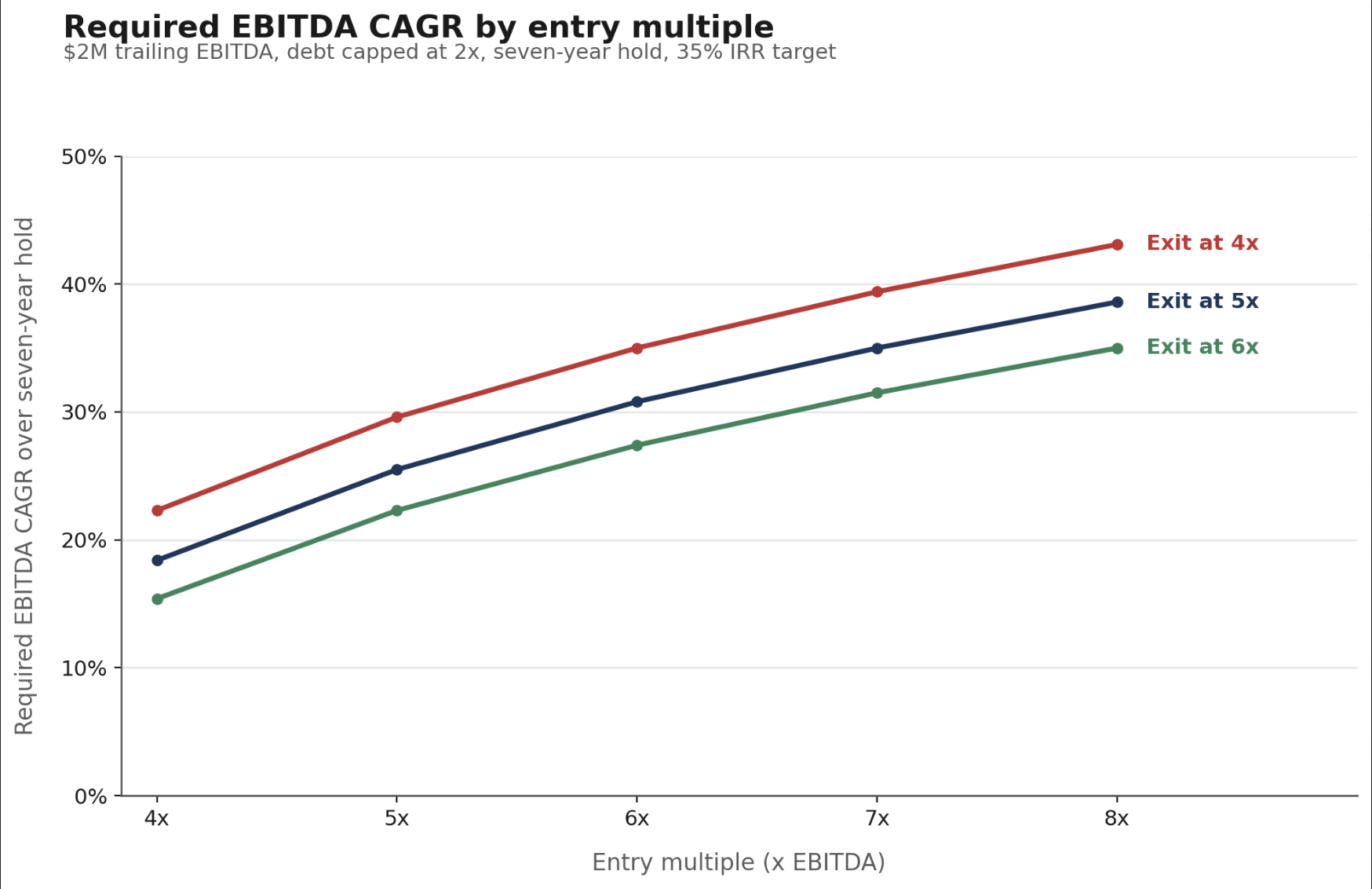
At a 4x entry multiple the required compounding is reasonable. By 6x, the bar nearly doubles. By 8x, you're underwriting venture-class growth on a business in transition.
The jump from 4x to 6x doesn't simply mean paying more. It means the EBITDA growth bar nearly doubles, and that bar has to be cleared by a first-time CEO running a business in transition.
You're layering growth risk on top of operator risk. More capital is at stake, the margin for error is thinner, and the business is already demanding more from you operationally. That combination raises a further question. Is the growth you're paying a premium for actually durable enough to justify the price?
The Revenue Quality Signal
Recurring revenue and strong customer retention sit at the heart of the search fund target profile. You accept a less exciting growth profile in exchange for predictability and durability of cash flows.
So what do you do when a business that fits the profile in every other respect is also growing unusually fast? The right response is to interrogate the growth. Understand what is driving it, and whether those dynamics are consistent with the revenue quality the model depends on.
Sometimes they are. A business growing at 20% inside an industry going through a durable structural shift, where switching costs are high and existing customers are expanding their spend, may represent a genuinely attractive opportunity. That kind of growth is sticky. It compounds on top of a strong revenue base rather than replacing it.
High growth can also tell a different story. A business consistently winning customers from competitors may be doing so precisely because switching costs in the industry are low. That dynamic works in both directions. If customers found it easy to move to you, they will find it equally easy to move away. Revenue that arrives quickly can leave just as quickly, and a new operator inheriting that kind of business is exposed to a reversal they may not have the experience to anticipate or the operational infrastructure to absorb.
Growth tells you that revenue is increasing. Retention tells you whether that revenue will still be there in three years. A business with 90% to 95% annual retention and modest compounding growth will often be a better fit for the model than a faster-growing business with elevated churn, even if the headline number looks less exciting.
Earn the Right to Grow
Growth itself is not the problem. In a search fund context it simply carries a different set of consequences than it does elsewhere, and reading those consequences accurately is the work.
The model generates returns through a specific progression. Buy well, stabilise, learn, then grow once you have the understanding to know where to push and where to leave things alone.
For a current searcher evaluating targets, the practical implication isn't to screen out growth. It is to interrogate it. When you encounter a high-growth target, ask what is driving it. Ask whether the revenue is durable or borrowed. Ask whether the multiple already reflects the trajectory, and if so, whether the heavier equity structure that follows changes the risk profile in ways you and your investors are willing to accept. A high-growth target acquired at a reasonable multiple with sticky revenue can still be a great outcome. Those conditions rarely travel together, and when they don't, the model is less forgiving than it appears.
There is no perfect business. Every deal you look at will have hair on it. The question is whether the specific risks you're taking on are the right ones for a first-time operator in a leveraged structure, or whether they're working against the very features of the model that are designed to help you succeed.
