
Why Business Acquisition Deals Fall Apart Before Closing

Finding the right business is only half the search. Converting it is the other half, and where many good deals fall apart. Part 1: Why 42% of Searchers Never Acquire a Business covered finding. This post covers the stretch from choosing which deals deserve an offer to the close, why deals die along the way and how searchers can improve the odds.
Part Two - Why Getting to Close is the Other Half
A search ends without an acquisition for one of two reasons. The searcher never finds a business worth buying, or finds one and can't get it across the line. Both end in the same place, the 42% of concluded searches in the Stanford data that finish without a deal.
The turning point is the letter of intent. Signing one buys exclusivity, a window of months in which to turn agreed terms into a closed deal. Diligence, the capital raise and the purchase agreement all run inside that window, and for many searchers it's all happening for the first time, with real money committed and the clock running.
The most recent Stanford study points to the acquisition rate falling in developed markets. Across four decades the rate is 58%. For funds launched between 2021 and 2024 it was 48%, against 86% for the 2007 to 2010 group. Stanford attributes roughly half the decline to tougher market conditions, and points to a wider range of preparedness as the model has grown popular.
Finding a quality business is a problem of search. Closing an acquisition is a problem of execution.
Why the Two-Year Search Is Shorter Than It Looks
Two years of funded capital sounds like plenty of time to buy one business. The data says otherwise. Time is the searcher's scarcest resource.
The early months rarely produce a deal. The sourcing engine is still being built, so the target lists and outreach systems aren't yet producing volume. The searcher is also still calibrating, working out what good enough looks like against real businesses rather than in the abstract. It takes a couple of months at volume before qualified conversations arrive, and longer before a searcher trusts their own read on one.
Among searchers who acquired in 2024 and 2025, Stanford found the first letter of intent came seven months into the search, and 2.5 letters on average to close a deal. The first attempt often dies, and each failure costs weeks or months depending on how far it got.
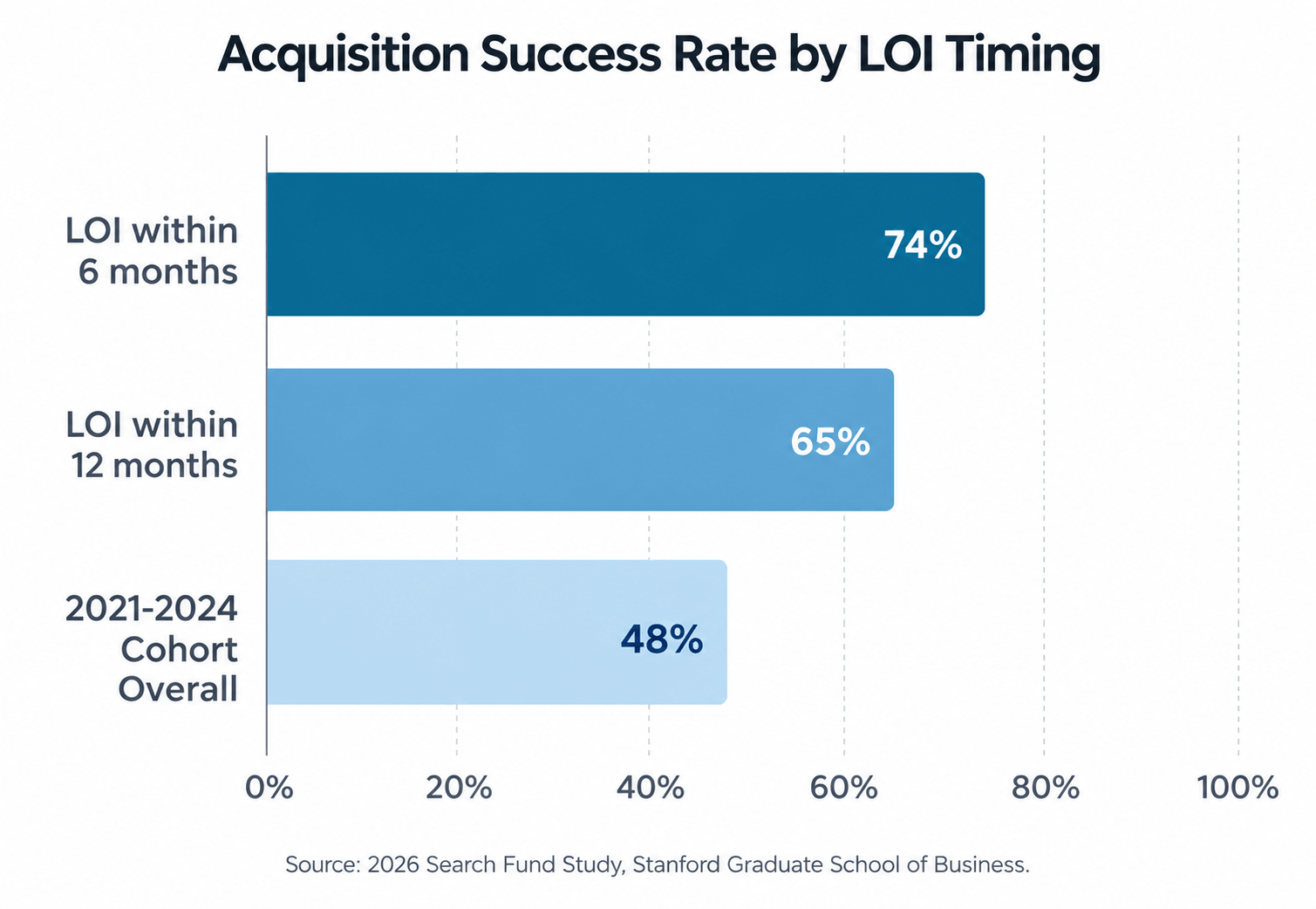
Searchers who signed a first letter of intent within six months acquired at 74%, and those who signed within twelve months at 65%, against 48% for that 2021 to 2024 cohort overall. Causation runs both ways. The qualities that produce an early offer plausibly help close one. But the gap is wide enough to treat the first offer date as a signal, not a milestone.
A deal that gets to completion consumes the better part of six months. Commercial diligence, a quality-of-earnings review and legal diligence take weeks and wait on the owner's records. The bank runs its credit process before committing debt. Equity investors do their own work before they wire. The purchase agreement travels between two sets of lawyers. None of those clocks belong to the searcher.
The runway divides unevenly. Seven months before a first offer, weeks or months on each attempt that breaks, and the better part of six months on the one that holds. The time left for filling the funnel is a fraction of the two years, and everything downstream depends on it.
Across all acquisitions in the study, the median time from the start of the search to a closed deal was 20 months, and 17% took 31 months or more. For the median searcher who gets there, the two years are nearly all used up.
Which raises the question of what a searcher spends that time on. Is this a business worth owning, and is there a reason a searcher is well placed to acquire it? The first is the more tangible question. The second can matter just as much in whether a deal gets to close.
The Deal That Got Away
One of our searchers spent months on a business with strong fundamentals. It had been trading for nearly three decades. Most of its revenue renewed on contract without anyone having to sell anything. The owner had built it from scratch and was approaching retirement.
A second business sat in the pipeline at the same time, similar in size but simpler, without the same recurring revenue. The first had stronger fundamentals, so we submitted the offer there and paused the conversation with the other owner.
The searcher did the work. A two-day site visit. Weeks of financing legwork when the banks proved wary of the balance sheet. Then a clean offer at a fair multiple, most of it payable on completion, the balance deferred, no earn-outs.
Late in the process, another bidder appeared. They hadn't been in the room for any of it, and they could pay more. The owner took their offer.
None of this means the deal was a mistake to chase. The business was sound and the offer was fair. But alongside the business risk the searcher was carrying a second one, and nothing about their position stopped a better-funded buyer from arriving.
The searcher introduced the owner to their own largest investor, in case the other deal came apart, then went back to the second conversation. Six days later they had an offer on it. It's the business they run today.
That risk wasn't hidden from us. We could see that an owner weighing price might take a better number, and we took it on because the fundamentals were strong. That was a defensible call and we would make it again. What came after was luck. The paused conversation was still there to pick up, and the other owner was still willing. A search can’t always depend on that.
Why Deals Still Die When the Process Is Run Well
There's another way deals fall apart, and this one is structural. A search fund is a private equity firm run by one person. Buying a company takes the same work whether there are forty people doing it or one.
Once the owner accepts the offer, every piece moves at once. Commercial diligence begins. The capital raise opens, equity on one track and debt on the other. The purchase agreement goes to the owner's lawyers. They run in parallel or the deal doesn't close. They also feed each other. A diligence finding moves the price. A moved price reopens the agreement and changes what the bank is funding. A delay in one stretches the other two. Every dependency runs through one desk and one calendar.
It's the busiest stretch of the search, and the most fragile. A searcher can run all of it well and still lose the deal. A risk surfaces that no reasonable indicative offer could have priced. A valuation gap opens and won't close. The debt or the equity doesn't come together. Or the owner changes their mind.
Stanford's 2026 study ranks the first three. Asked why a letter of intent failed, 79% of respondents named something discovered in due diligence, 45% named a valuation difference with the business owner, and 40% named a lack of investor support. Diligence is also the risk a searcher can do the most about. Aim the first weeks of exclusivity at whatever would kill the deal, so that if it exists it surfaces while walking away is still cheap.
The owner changing their mind is harder for a searcher to mitigate. Diligence takes months, the business trades through all of them, and an owner watching good month follow good month with a buyer's paperwork on the desk can decide to keep the company. The rest turns on preparation done before exclusivity begins. Sign only when the evidence says the deal can close, and the first piece of evidence is the owner. Someone ready to sell now, on their own timeline, isn't the same counterparty as someone quietly testing the market. Before diligencing the business, diligence the owner.
Terms are the other half of that preparation. The clauses that blow up deals late are the ones left vague early, so put positions on the hard terms into the letter of intent while goodwill is high. The working capital peg, agreed as a formula rather than a dollar figure. The earn-out and the seller note. Key-management retention, the transition period, the non-compete.
Not every unsigned offer dies at the owner's hand. Sometimes the searcher is the one who ends it.
The Offer a Searcher Walked Away From
Another searcher we work with had an indicative offer out on a group of related companies with roughly $20M of combined revenue. Eleven days after it went in, they pulled it. Their investors had pressed on two things, the complexity of stitching the businesses together and the quality of the margins in the largest one, and the searcher agreed. On the same call, they named the business they would pivot to, one that had been sitting in the pipeline for months. They own it today.
Several businesses stitched together means several sets of books, several customer bases, and many more ways for the price to move once someone looks closely. The conclusion took eleven days. In month four of exclusivity it would have cost most of what was left of the search.
An offer can die unsigned for reasons you can't control, like a bidder who turns up late with more money, or for reasons you can, like your own investors' verdict. Either way, the searchers who ended up as owners were the ones still running a live pipeline while their favourite deal was on the table.
Neither of those two offers was ever signed, which puts them earlier than the failures Stanford counts. Those are letters of intent that came apart once diligence was underway. A deal lost before the signature leaves no paperwork behind, so it never reaches the data at all.
Two Things Searchers Can Take From This
Price the risk that sits with the owner.
A business can be sound and an offer fair, and the deal can still fail because of where the owner is and who else is talking to them. That risk is reducible. A relationship built over months is worth something a late bidder can't replicate quickly, and so is a clear answer to why a search fund buyer suits this owner better than private equity or a strategic acquirer would. Without that answer, the deal depends on nobody else turning up.
Treat complexity as completion risk, not only business risk.
Complexity works against a searcher twice over. It can hide something that surfaces only once diligence goes deep. And it lowers how well the business is understood at the point a number goes on it, which raises the chance of having to re-price later. That is worth a post of its own, and I will come back to it.
Part One ended on volume, on the idea that breadth is how a searcher finds the one. This half asks for something different. Closing rewards knowing, before the clock is committed, why this deal is yours to win.
The search is won twice. Once when you find the business, and once when you close it.
-
Note on the figures. The most recent Stanford cohort is only 42% concluded, so the recent acquisition rate will move. The study does not split the decline between finding and closing, and its respondents could give more than one reason for a failed letter of intent, so those percentages do not sum to 100.
Examples in this post are based on real situations at SMEVentures, with names, industries, numbers and other identifying details changed to anonymise the businesses and people involved.
