
Why 42% of Search Fund Searchers End Without a Deal

Close to 42% of traditional search fund searches end without an acquisition. Stanford Graduate School of Business data, tracking 862 funds since 1984, puts the acquisition rate at roughly 58%. The gap is not caused by a shortage of businesses for sale. It is caused by the extreme scarcity of businesses that meet search fund criteria and a competitive landscape that favours larger buyers.
Part One - Why Finding a Business Is the Hard Part
What Percentage of Search Fund Entrepreneurs Fail to Acquire?
On paper, a search fund should almost always end in an acquisition. A capable operator raises two years of dedicated capital and sets everything else aside. The whole job is to find and buy one good business. The people who get funded are chosen carefully and backed by experienced investors. The timeline is long and the mandate is narrow. Almost everything about the structure is built to produce a deal.
Many don't. The largest study of the model, run by Stanford, has tracked 862 funds across the US and Canada since 1984. Over the last decade the acquisition rate has held around 58%, so of the searches that conclude, close to 42% end without a deal. The study runs through 2025, and the rate is declining. Funds launched between 2021 and 2024 acquired at 48%, against 86% for the 2007 to 2010 group.
That gap is the interesting part. The useful question isn't whether 42% is too high, or what it says about the people who don't make it. It's why the number is what it is. Why does a capable operator, funded and working full time for two years, so often finish with nothing to show for it?
A search that ends without an acquisition fails at one of two points. The searcher never finds a business worth buying, or finds one and can't get it to close. These are different problems with different causes, and they're worth treating separately. This is the first of a two-part series. It's about the first failure, finding the business.
Why the Right Business Is So Hard to Find? Supply Isn't the Problem
Begin with the objection that finding should be easy. There's no shortage of businesses to buy. Nearly half of baby boomer business owners plan to retire within five years, and two in three have no documented succession plan. The silver tsunami is real, and it isn't slowing. If the search were only a matter of finding a company whose owner wants out, two years would be more than enough.
The constraint isn't supply. It's fit. A searcher isn't looking for just any business. They're looking for a particular kind, and each feature that makes a business a good fit also makes it rarer. Recurring revenue that doesn't have to be re-won each year. Profits that don't depend on the owner doing everything themselves. A customer base that isn't one account away from a cliff. A reason the business keeps winning that will outlast the seller. None of these is an unusual thing to ask for. The catch is that each one, reasonable on its own, rules out a large share of the market, and a searcher needs all of them at once.
Most searchers target roughly $2 million to $7 million of EBITDA, and that band alone rules out most companies. The lower bound is about whether a business is worth buying at all. It has to be big enough to support a CEO's salary, carry acquisition debt, and justify years of a talented operator's life. The upper bound is about competition. The bigger the business, the more buyers it draws and the more transparent and competitive the sale. The result is a narrow band, with the vast majority of small businesses falling outside of it.
Concentration is the other big one, and it's particularly a small-business problem. A smaller company is far more likely to lean on one or two big customer accounts. A business like that can tick every other box, recurring revenue, healthy margins, a clean story, and still be uninvestable because a single customer is half its revenue. Concentration is one of the most common ways an otherwise attractive small business comes off the list.
Put the filters together and the picture inverts. The question was never whether anything is for sale. It's whether anything for sale fits the model and the size, and very little does. A searcher isn't sifting a big pile for a good one. They're hunting a small pile scattered across a much bigger one. And even that small pile overstates what a searcher can actually buy.
Why Searchers Lose to Private Equity and Strategic Buyers
Suppose a searcher surfaces a business that fits. The right size, recurring revenue, a clean customer base, an owner ready to move on. That still isn't a deal, because finding a business and being able to buy it are not the same thing. Businesses like this are in demand. The traits that make a small company attractive to a searcher make it attractive to other buyers too. The more appealing the business, the more competition a searcher faces for it.
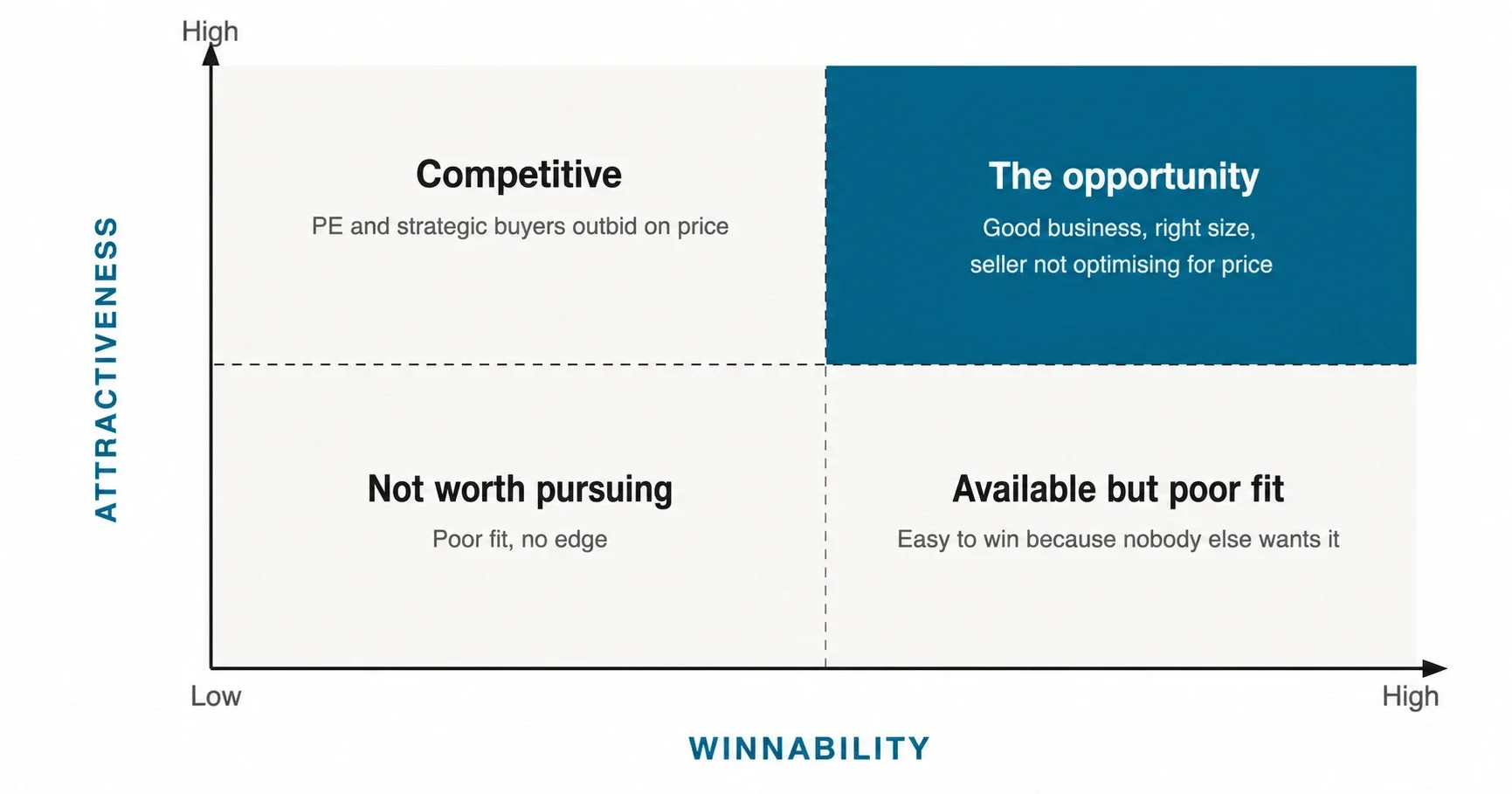
In a competitive process where the owner is optimising for price, a searcher is usually the wrong buyer to win. The reason comes down to the return each buyer needs. A searcher's investors are backing one first-time operator buying a single leveraged business. That is a concentrated bet, and the model targets a 35% IRR to compensate for the risk. A private equity firm, investing across a portfolio, can underwrite to the high teens or low twenties. A strategic acquirer already in the industry may need less again.
That difference decides who can pay. A private equity form or a strategic acquirer can pay more for the same business and still hit their return targets. The strategic often has more room still, because it can realise cost synergies and sell through channels it already owns. None of this makes those buyers aggressive or wrong. They simply value the same business more highly, and in a price-led process the highest credible bid tends to win.
We saw this directly last year. We were looking at a business with high-quality recurring revenue, asset-light, and growing year on year. One of our searchers submitted an offer, and the owner went quiet for a while. It turned out they were in conversation with a private equity buyer who had offered a much higher price. The business was excellent. That was exactly the problem.
None of this puts competitive processes off the table. Plenty of searchers buy businesses that come through a broker. But it changes the question. The question isn't only whether the business is good. It's whether the searcher can win it. The businesses worth chasing are the ones that are both attractive and winnable, and telling the two apart early is part of the work. By this point the pool looks vanishingly small. Good businesses, the right size, that a searcher can actually win, are rare. That scarcity creates the opportunity for a talented entrepreneur backed by a group of sophisticated investors to find an attractive business at a reasonable price.
How Searchers Find What the Market Misses
Markets are reasonably efficient. A genuinely good business offered at a fair price attracts buyers, and competition closes the gap between price and value. If a quality company at a reasonable multiple were easy to find, someone would already have bought it. The opportunity exists because finding one is hard. It's the operator willing to spend two years searching full time who creates an opening an efficient market would otherwise have closed.
That should shape how a searcher reads an opportunity. If the easy bargains are gone, then any business a searcher can buy well is one the market has, in some specific way, mispriced or overlooked. So the question to ask of a promising target isn't only whether it's a good business. It's why this one is available, at this price. What does the market not see here, or not care about, or have no way to act on?
Usually it's one of three things. The first is a seller who isn't optimising for price. After decades building the business, an owner often cares as much about who takes it on, and whether their staff and their name survive, as about the last dollar. The second is effort. A searcher who reaches out to thousands of owners can catch one at the moment they're starting to think about moving on, before they've engaged a broker or opened a process, when there's no auction to lose. The third is the searcher themselves. They aren't a fund that will fold the business into a portfolio. They're the person who will take it over and run it, and that lets them build a relationship with the owner that an institution can't. A private equity buyer shows up as an associate, a strategic as someone from corporate development. A searcher shows up as the future owner, and for a seller who cares how the story ends, that can be the difference.
One of our recent acquisitions came down to exactly this. A private equity bidder had offered a higher price, with a credible plan to grow the business quickly over the next few years. But the seller cared deeply about the company and the people in it, and about who would take it over and run it. He chose to sell to one of our searchers, at a lower price, because of the kind of owner the searcher would be. The private equity offer was perfectly reasonable. It just wasn't what the seller was optimising for.
None of it is luck. A searcher finds the right seller by doing the volume, and wins them by being the right kind of buyer. That's the opportunity. Good businesses available at a fair price are rare, and the search is the work of turning them up. Which leaves the practical question. Given that this is the job, how does a searcher do it well?
Why Outreach Volume Matters More Than Anything Else
The answer, more than anything else, is volume. Think about how much has to be true of one business at once. It has to be the right kind of business, at the right size, and for sale at a price that works. The odds all of it lands in any single company are low. The way to make a low-probability event happen reliably is to give it enough attempts. Volume turns a long shot on any one business into a real chance across a whole search.
The data bears it out. Among searchers who acquired in 2024 and 2025, Stanford found 2.5 letters of intent on average, the first signed seven months into the search.
This is why a traditional funded search is usually run wide. Investors expect a searcher to stay sector-agnostic and geography-agnostic, and the reason is the same arithmetic. A wider aperture means more companies in view, and more companies means more chances the rare combination turns up. Narrowing to one industry or one city can feel more focused, but it shrinks the pool. The breadth isn't indecision. It's how a searcher maximises the attempts at the one business they need.
Volume does more than add attempts. The more owners a searcher talks to, the faster their judgment sharpens, and the quicker they can tell which businesses deserve more time. Each conversation is also a relationship begun, the kind of edge that wins the deals price alone never will. The same work that improves the odds of finding the right business improves the odds of recognising it, and of being the one the owner picks.
None of this guarantees the outcome. A searcher can run a wide, high-volume search and still finish without a deal that clears the bar. But volume is the largest input a searcher controls, and it moves the odds more than anything else they can do. And the goal is smaller than the effort suggests. A searcher doesn't need to find many businesses, or beat the market, or win every deal. They need the search to surface and land one. Volume is simply how you find the one.
But finding the one is only half the search. A business you've found is not yet a business you own, and closing that gap is where a real share of searches still come undone. That is the other half, and it's where we'll pick up in our next blog post.
