
How Working Capital Works (And Why It Matters More Than You Think)

At SMEVentures, we put working capital on the table early in every deal we work on. It’s not the most important number in a transaction, but it’s one of the most consistent sources of late-stage risk we’ve seen. Left late, it can break a deal that should have closed. Raised early, it’s usually a conversation rather than a fight.
When deals do break on working capital, it’s almost always for the same reason. The conversation between buyer and seller hasn’t happened early enough. By the time both sides are in the SPA, the gap in how each one thinks about the cash inside the business has had months to widen.
This isn’t a post on negotiation tactics. It’s an explainer of what working capital is, how it interacts with the price, and why getting buyer and seller on the same page early is what prevents a late-stage breakdown.
One frame worth holding from the start. When a searcher buys a business, they are buying a going concern. The price is the price of the going concern. Thinking of the deal as “EBITDA multiple plus working capital” is the wrong frame. Working capital isn’t a separate asset stacked on top of the deal. It’s part of what makes the business a going concern at all. The receivables, the inventory, the payables, the prepayments. None of it is optional kit. The business doesn’t run without it.
Hold that frame and the rest of the conversation gets easier. Lose it and you end up in a fight near the finish line that should have been a conversation at LOI.
So if you’re looking at deals right now, the question is simple. What is working capital actually doing in this deal, and how do you have the conversation in a way that doesn’t blow up at close?
1. What Working Capital Actually Is in an SME
The textbook definition is current assets minus current liabilities. That’s accurate. It’s also useless in a real conversation with an owner who has run her business for twenty years without ever putting those words together.
The more useful frame is this. Working capital is the cash the business needs to keep operating in the gap between paying its costs and getting paid by its customers. It’s not a separate asset that sits alongside the business. It’s part of how the business runs. Without it, the operating engine seizes.
In practice, working capital in an SME has two sides. On one side, the assets that tie up cash. Receivables sitting on the debtors ledger waiting to be paid. Inventory on the shelf waiting to be sold. Prepayments to suppliers covering services not yet delivered. On the other side, the liabilities that release cash. Payables owed to suppliers. Accruals for work done but not yet billed. Customer deposits and unearned revenue, where the customer has paid for something the business hasn’t yet delivered.
The net of those two sides is the working capital number. But the number on its own doesn’t tell you much.
What you actually need to know, on every deal that reaches LOI, is the answer to two questions. How much working capital does this business need at any given time to operate normally? And is the level sitting in the business today representative of what it’ll need next month, next quarter, next peak season?
Get those two questions answered properly and the rest of the conversation is mechanical. Skip them and you’re flying blind into the SPA.
2. Why Buyer and Seller See This Differently
Most owner-operators don’t think about working capital as a coherent number, and there’s no reason they should. They built the business over a decade or two. They know the bank balance to the dollar. They know roughly who owes them money and roughly what they owe. But the bank balance, the tax bill, the debtors ledger and the supplier payables sit in their head as separate things. They’re not stitched together into a single concept called net working capital.
So when the cash and the receivables come up in deal conversations, the owner’s instinct is straightforward. The cash in the bank is hers. She earned it. The money customers owe her is also hers, because she did the work to invoice for it. Neither of those is, in her mind, part of what she’s selling.
The buyer is looking at the same business through a completely different lens. Cash and receivables are part of the operating engine. They’re not a bonus that comes with the deal. They’re what allows the business to make payroll, pay suppliers, and fund the next month’s invoices on Day 1. If they walk out the door with the seller, the buyer has to inject capital just to keep the lights on the morning after close.
Both views are reasonable inside their own frame. The owner isn’t acting in bad faith. The buyer isn’t being greedy. They’re just looking at the same balance sheet and seeing two different things.
The trouble is the disconnect doesn’t surface on its own. It surfaces when someone forces the question. And if no one forces it until the SPA stage, the seller has spent months mentally banking the cash and receivables as money she’s about to walk away with. Telling her otherwise in the weeks before signing is the worst possible time to start that conversation.
This is the gap a searcher’s job is to close, gently and early. Walk the seller through what’s actually being priced. Show her the operating cycle. Explain why the receivables travel with the business. Done at LOI, it’s a half-hour of explaining where you both are. Done in week eleven, it’s the kind of conversation that gets a deal pulled.
3. The Peg, What It Is and How It Works
The mechanism that resolves the disconnect is the peg.
The peg is the reference level of working capital the buyer expects to take over inside the business at close. Whatever the actual working capital position turns out to be on the day, it gets measured against the peg. If working capital lands above the peg, the buyer pays the excess. If it lands below, the seller funds the shortfall.
What gets settled when is the part that trips people up. The methodology for calculating the peg gets agreed at the Heads of Agreement stage, before financial diligence kicks off in earnest. The methodology spells out the lookback window, what’s in and what’s out, how seasonality and one-offs will be treated, and which items are being carved out as debt-like rather than working capital. The actual peg number is then calculated by the buyer’s accountant during financial diligence, using the agreed methodology, and negotiated to landing with the seller’s side. The final number, plus the definition that produced it, goes into the SPA.
Two approaches exist in market. The one described above, with methodology agreed at HOA and the number calculated during diligence, is the one we use most often at SMEVentures. In some deals, particularly where competitive tension is high, buyers will commit to a specific peg number in the LOI itself to remove a re-trade vector during diligence. The trade-off is pre-LOI certainty against post-diligence confidence in the number. For a searcher with one shot at the business, that trade-off usually points to methodology-first.
One framing point worth flagging up-front. The peg and true-up mechanic described in this post is a share-purchase construct. In asset deals, the working capital that crosses to the buyer is typically defined directly in the schedule of assets and liabilities being acquired, and the peg structure is much less relevant. The economics still net out across the two. In a share sale you pay an enterprise value that already assumes a normal level of working capital and inherit it through the peg. In an asset sale you pay that enterprise value less the working capital, because you fund the operating cycle yourself after close. Working capital washes out between the two structures, and what doesn’t wash out sits in the net-debt items, which is beyond this post. Most search fund deals in Australia and New Zealand are share purchases, so the mechanic below is the one that applies.
To make this concrete. On one acquisition we backed, the seller’s opening expectation, sitting roughly in line with the trailing average, put the peg in the order of $1.8m. The methodology in the HOA called for trailing 24 months, seasonality-adjusted, debt-like items carved out. When the buyer’s accountant ran that methodology during diligence, the number came back around $3.5m. After a few rounds with the seller’s side, the peg landed close to the higher number. It turned out to be the single most consequential commercial decision in the deal. It gave the searcher roughly $1.7m of additional headroom on Day 1 and fully funded the operating cycle from the morning after close. None of that was free money. At the seller’s $1.8m anchor, that $1.7m would have left as cash in her hands, with the buyer funding it straight back in on Day 1. Getting the peg right didn’t create value so much as stop it walking out with the seller. The chart told the story. The methodology made the number defensible.
What the peg specifically protects against is the quiet shift in incentives that happens in the months between LOI and close. The seller knows the cash is going to be settled separately, on a cash-free debt-free basis. They keep the cash. They clear the debt. So the rational thing for them to do, consciously or otherwise, is to convert as much working capital into cash as possible before close. Push AR collections. Stretch payables. Run inventory down. None of this is bad faith. It’s what anyone would do if they hadn’t agreed otherwise.
The problem is that every one of those moves strips working capital out of the business the buyer is about to inherit. The peg is what holds the level constant. It says, you’re delivering this much working capital at close, regardless of how you got there.
On that same deal, the searcher noticed something specific in the months between HOA and close. The seller had quietly started chasing receivables harder once the methodology was locked in. Debtor days dropped meaningfully across the six to seven months between HOA and completion. It wasn’t bad behaviour. It’s what any owner would do once they know the cash is being settled separately. The peg held the working capital level constant, so the cash benefit from tighter collections stayed inside the working capital calculation rather than walking out with the seller. The buyer got what was agreed.
At close, working capital is measured against the peg. If actual Net Working Capital (NWC) is below the peg, the seller pays the buyer the shortfall. If above, the buyer pays the seller the excess. This is the true-up. The mechanics for how the calculation is run, the window to dispute, and how unresolved disputes get resolved by an independent accountant all sit inside the SPA. The detail is standard but it has to be drafted properly. A loosely-written true-up clause is where the post-close fights start.
The reason both sides benefit from a clean peg is that it takes the operational ambiguity out of the deal. The seller knows exactly what she’s delivering. The buyer knows exactly what he’s receiving. The economics of the transaction move with the operating reality of the business, not with whatever collections sprint or payables stretch happened to land in the last six weeks. The headline number stays the number. The peg quietly does the cleanup behind the scenes.
4. Setting the Level, What to Actually Look At
The mechanical answer to where the peg should land is often the trailing 12 to 24-month average of the business’s working capital position. That answer is correct. It is also, on its own, rarely enough.
Better practice is to build a monthly working capital chart covering the trailing 24 months. Plot the actual position month by month. Look at the peaks. Look at the troughs. Look at the trend.
The chart will show you things the average can’t. A business with strongly seasonal customers has working capital that peaks before the seasonal sales run, when inventory has been built up and AR is climbing, and troughs once collections come in. A business with one or two outsized customers has a working capital position that moves with their payment behaviour. A business that’s been stretching AP over the last six months will show a working capital trend that drifts downwards in a way the trailing average masks.
The adjustments you make from there are the ones any decent diligence process would make anyway. Strip out one-off contracts that built or released inventory unusually. Normalise for tax-timing distortions. Watch for AP stretching in the months before sale, which shows up as creditor days lengthening. None of this is exotic. It just has to actually get done.
The trap to avoid is treating the average as the answer on its own. A business that swings between $500K and $1.5M of working capital across the year is in a different position on an October close than on a February close, and the peg has to acknowledge where in the cycle the business is being handed over. The average flattens that out. Used uncritically, it leaves one side or the other funding the difference between the calendar and the cycle.
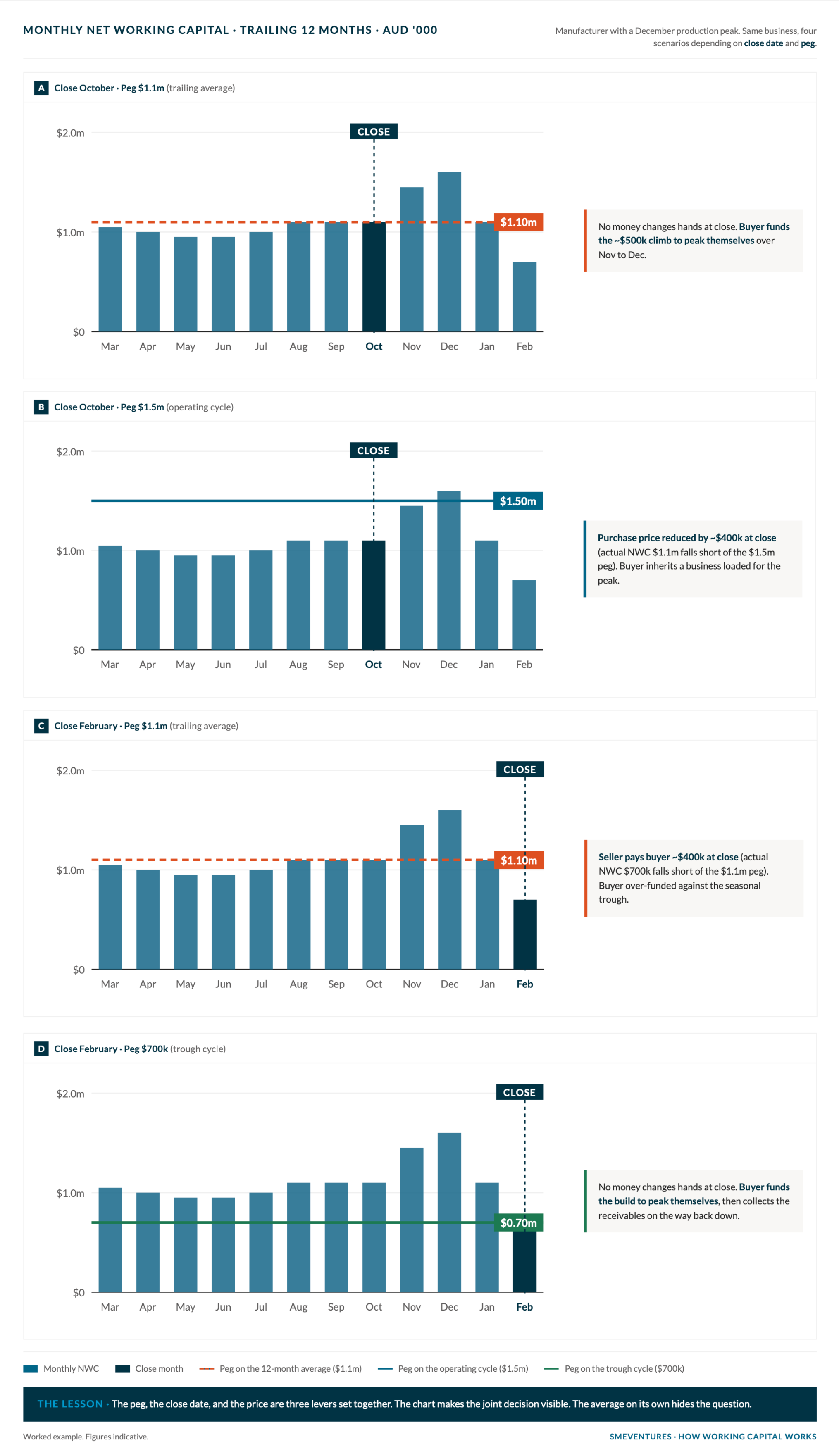
A worked example makes the trap concrete. Think of a manufacturing business with peak working capital of around $1.6m heading into a December production run, troughing at $700k by February once collections clear and inventory winds down. The trailing 12-month average sits near $1.1m. Set the peg at $1.1m and close the deal in October, and the buyer is taking on a business about to climb roughly $500k towards its seasonal peak. That $500k now comes out of the buyer’s pocket on Day 1. Set the peg closer to $1.5m and the maths reverses. The seller delivers a working capital position that matches the operating cycle, and the buyer doesn’t have to fund the seasonal build. That isn't automatically the right answer either. A $1.5m peg on an October close means the seller is delivering working capital they haven't fully built yet, and the price has to acknowledge that. The point isn't that one peg is right and the other wrong. The point is that the peg, the close date, and the price are three levers that have to be set together, and the chart is what makes that joint decision visible. The trailing average on its own hides the question.
The level the peg eventually lands at is a function of the actual operating cycle of the business. B2B businesses with 60 or 90-day payment terms carry meaningful receivables. Service businesses billed monthly carry far less. Inventory-heavy businesses tie up cash that service businesses don’t. The chart will show whatever the business actually does, across whatever cycle it actually runs. That’s the basis for the conversation with the seller, not a textbook target or a rule of thumb pulled from a different industry.
5. The Conversation With the Seller
The way in which the working capital discussion opened matters. Don’t lead with a number. Lead with the data.
Whoever’s running the conversation, open by sharing the trailing 24-month chart that’s been built. Walk through the peaks and the troughs. Show how the working capital position moves with the seasons, the customer payment cycle, the inventory builds. The chart does the work that a sentence can’t. By the time the question of where the peg should sit comes up, both sides are looking at the same picture. The discussion is grounded in what the business has actually done, not in two sides bringing different anchors to the table.
From there, the same four or five objections come up in almost every conversation. Your job is to have a good answer ready for each one.
“The cash is mine.” Mostly, yes. The peg itself is calculated exclusive of cash, and on a cash-free debt-free basis the cash balance walks with the seller. Completion working capital is measured on that same basis, so cash isn’t pulled into the number itself. What moves cash is the settlement at close, not the calculation behind it. The true-up measures actual working capital against the peg, with cash and debt settled separately alongside it. If working capital comes in below the peg she funds the shortfall, and that nets against the cash she’d otherwise walk away with. Anything above the peg, the seller takes with her. The principle holds. What the peg is really about is the operating receivables and payables that travel with the business, and the cash gets settled around them.
“The AR is mine. I did the work for it.” The work is done, and the EBITDA she’s being paid a multiple on already reflects that work. The receivables themselves are different. They’re part of what makes the business function. If they leave with her, the buyer has to inject cash on Day 1 to replace them. So either the receivables come across and the buyer pays the agreed price, or they don’t come across and the price comes down to reflect the gap. Both are valid structures. They’re just different deals.
“I’ve always run on low working capital.” Possibly. The chart will tell you when. The peaks usually tell a different story than the year-round picture.
“My customers pay reliably.” Reliable and quick are different things. Pull the DSO across 24 months. If it’s been sitting at 65 days the whole time, the customers are reliable. They’re also slow.
The principle underneath all of this is that you’re not running a negotiation. You’re running a calibration. The goal is for both sides to understand exactly what’s being priced and exactly what’s being delivered, and to agree on the level before anyone has signed anything material.
This is also why early matters most. Every one of those objections is easier to work through in week one of an LOI conversation than in the final week before signing the SPA. At the start, the seller has nothing locked in mentally. She’s still figuring out what the deal looks like. By SPA stage, she’s spent months thinking of the cash and receivables as proceeds. The deal point that gets surfaced at LOI rarely kills a deal. The same point surfaced at SPA stage often does.
6. The Process That Closes the Gap, End to End
The objections from the seller side are predictable, and walking through them in the moment is hard. What makes the working capital conversation actually land is a documented process, run in the right order, ahead of signing. Four steps in particular have made the difference across the deals we’ve worked on.
Step 1. Make sure the seller has an M&A-literate advisor.
Working capital pegs are standard in M&A. They are not standard in everyday SME accounting. A seller’s long-standing tax accountant who does the BAS and the year-end may never have seen a peg in their career. A seller’s M&A advisor, broker, or transaction lawyer will recognise the framing immediately. Asking the seller, at LOI stage, who is advising them on the transaction is one of the most useful questions in the entire process. If the answer is the tax accountant only, the deal needs the seller to bring in someone with M&A experience before the peg conversation gets serious. The whole subsequent conversation runs faster between two parties who use the same vocabulary.
Step 2. Calculate a proposed peg with the buyer’s accountant.
Trailing 24 months of monthly NWC, plotted. Adjustments line-by-line for seasonality, one-offs, and timing. Definitions of every line item, including which items are operating and which are debt-like. The output is a proposed peg with workings, not a number on its own. The seller can disagree with the workings, and often will. What they can’t disagree with is that the workings exist.
What the workings look like in practice, using the same manufacturing business from earlier in this post.
Trailing 12-month average NWC sits near $1.15m. The peg starts there and gets adjusted, line by line, for the things the average is hiding.
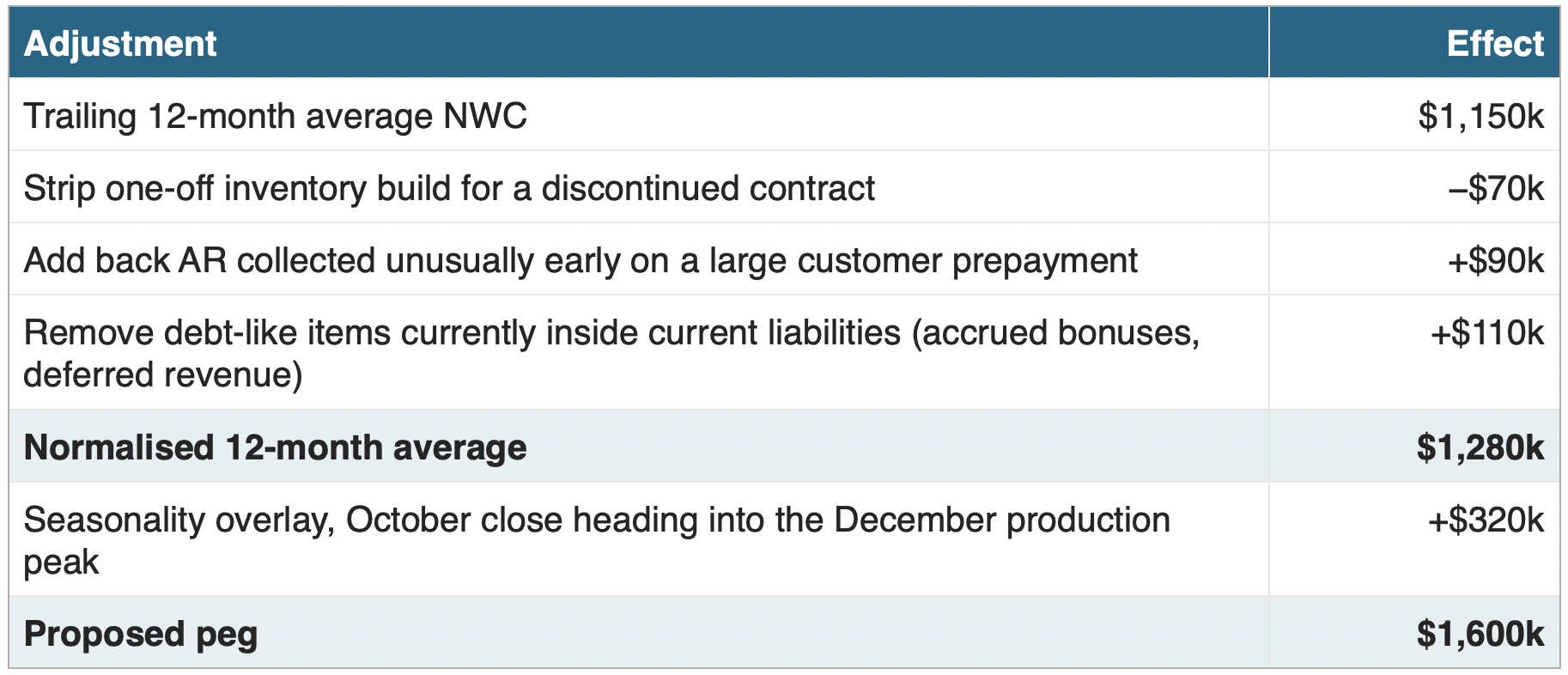
The four panels in the Section 4 graphic are indicative — same business, four off-the-shelf peg-and-date combinations to show how the levers interact. Step 2 is what one of those panels looks like after the normalisations the actual business needs: the operating-cycle peg from the October-close panel, plus the line-by-line adjustments above, lands at $1,600k rather than the indicative $1.5m. The proposed peg gets put to the seller with the chart, the normalisation table, and the seasonality logic. Not as a take-it-or-leave-it number, but as a position with workings. The seller’s first instinct will be to anchor on the trailing average, which in this example would leave the business under-funded by roughly $450k on Day 1 of the December run.
Step 3. Get the accountants aligned, and decide who runs the conversation with the seller.
Who actually walks the seller through the peg is case-by-case. With a financially fluent seller, the searcher can do it directly, and the accountants align in the background on the technical definitions. With a seller whose comfort zone is the year-end and the BAS, the better move is usually to have the buyer’s accountant talk to the seller’s accountant first, then let the seller’s accountant — someone she already trusts — walk her through it on her side. Either route runs on the same material in the same order; what differs is who’s in the room when the seller first sees the chart.
Either way, the accountant-to-accountant channel does a lot of work. Two people, same vocabulary. By the time the principals reconvene, the framing argument has usually been resolved at a technical level, and the discussion is about the number rather than the concept. This single step de-escalates more peg conversations than any other.
Step 4. Bolt a pro forma completion statement into the SPA itself.
This is the step that prevents the SPA-stage explosion. Take the company’s own balance sheet. Map every working capital line item, by general ledger code, into the completion calculation that will run at close. Run the numbers as if the business closed today. The seller sees, in advance, exactly what the calculation will look like on the day, against the same accounts they recognise from their monthly management reports. That pro forma completion statement then goes into the purchase agreement as a schedule. The SPA does not say “working capital, as defined”. It says “working capital, calculated as set out in Schedule X, which produces the worked example below using the company’s balance sheet as at [date]”. When the buyer’s accountant runs the real completion statement after close, the seller is looking at the same template they signed up to. Nothing in the calculation is a surprise.
The four steps are sequential, and most of the cost is in steps 2 and 4. Done in that order, the seller hears working capital as a calibration rather than a negotiation. The chart, the workings, the accountant-to-accountant alignment, and the worked example sitting inside the SPA all push in the same direction. The methodology gets agreed before LOI, the number gets agreed before anyone has signed anything material, and the documentation does the rest.
Closing
Come back to what you’re actually paying for. The headline multiple is shorthand. The going concern is the thing. The price you’ve agreed on is the price of a business that runs the day after close as it ran the day before, with the receivables it had, the inventory it had, the payables it had. Working capital is part of that going concern. It isn’t a separate line stacked on top of it.
Even when you do all of this right, things can still walk in heavy on settlement morning. On a recent acquisition we backed, the stocktake done two days before completion came in around $400k above where the model had it. The buyer didn’t have spare cash to fund EV plus working capital plus an unexpected $400k of additional stock, and still leave the business with enough cash on Day 1 to make payroll. The completion-accounts mechanic in the SPA gave both sides a window to resolve it. The parties used a side letter to defer payment of the excess stock by a few months. The buyer got Day 1 cash. The seller got paid in full inside the agreed window. The surprise didn’t break the deal, because the mechanism existed when it was needed.
The practical takeaway for searchers actively looking at deals right now is small and concrete. Build the trailing 24-month working capital chart on every deal that reaches LOI stage. Sit down with the seller and walk through it together. Agree the methodology for the peg at the Heads of Agreement, calculate the number with your accountant during financial diligence, and write the definition of what’s in and what’s out into the SPA itself.
Deals don’t fall apart over working capital because the number is hard. They fall apart because the conversation didn’t happen early enough.
———
*Examples in this post are based on real situations we’ve come across at SMEVentures, with numbers changed to anonymise the businesses involved.
This blog is for general informational and educational purposes only and does not constitute financial, legal, tax, or professional advice. Before making any acquisition or business decisions, seek advice from qualified professionals familiar with your specific circumstances.